
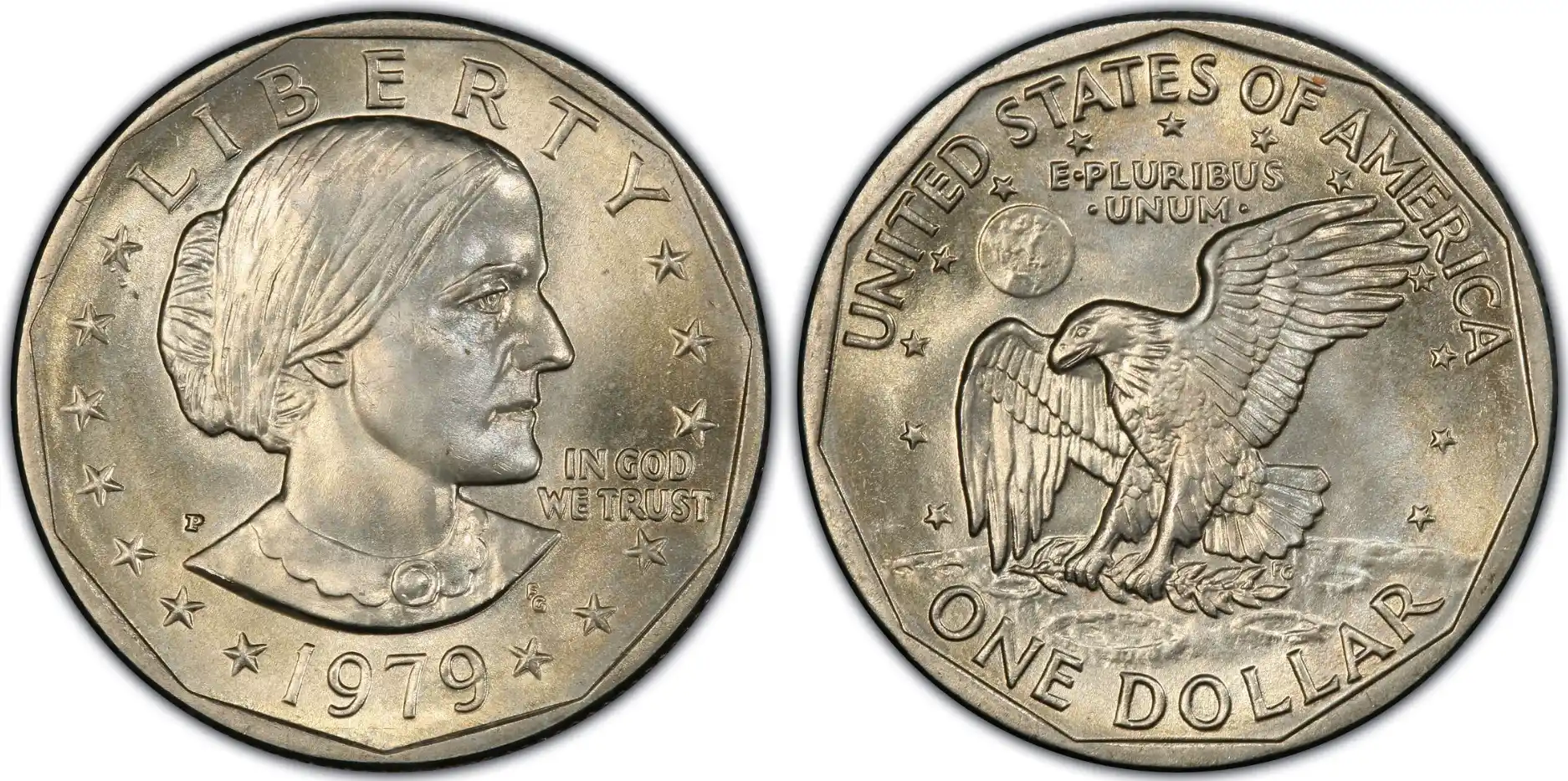
Common worn metal dollars 1979 have a low $1-$1.2 market 1979 dollar coin value. Coins in excellent mint state without wear show a real $3-$15 price range. Rare mint error varieties sell in a huge $100-$8000 price range on auction platforms.
| Coin Parameter | Standard Measure |
| Face value | $1 |
| Metal weight | 8.1 grams |
| Coin diameter | 26.5 millimeters |
| Coin thickness | 2.0 millimeters |
| Metal composition | 75% copper and 25% nickel |
| Edge type | Reeded |
Standard Strike Dollar Market Value
Regular Susan B Anthony dollar market value depends heavily on mint mark letters. Mint facilities in Philadelphia, Denver, and San Francisco created giant mintages. Due to this, standard circulated coins carry no collector premium. Their price is exactly $1. Uncirculated coins still sell above face value.
Philadelphia Mint 1979-P Dollars
Philadelphia Mint workers produced 360,222,000 standard strike coins. Most coins stayed in bank vaults. This high availability keeps standard coin value low.
| Coin Grade | Real Price Range |
| MS60 | $1.2-$2 |
| MS63 | $2-$4 |
| MS65 | $6-$12 |
| MS67 | $45-$80 |
Philadelphia 1979-P standard strike dollar record price is $3,819. Auction house Heritage Auctions sold this piece. Buyers pay such high prices only for certified coins without metal scratches.
Denver Mint 1979-D Dollars
Denver Mint workers produced 288,015,744 coins. Coins with a D mint mark often look great. Most Denver coin prices remain very affordable.
| Coin Grade | Real Price Range |
| MS60 | $1.2-$2 |
| MS63 | $2-$3 |
| MS65 | $5-$10 |
| MS67 | $35-$70 |
Denver 1979-D MS68 dollar record price is $13,781.25. Auction firm GreatCollections sold this coin. This sale is an extreme event caused by heavy bidder competition. Normal investors cannot expect this amount for standard pieces.
San Francisco Mint 1979-S Dollars
San Francisco Mint workers produced 109,576,000 standard strike coins. These coins show an S mark on the front side. This mintage is smaller than Philadelphia and Denver outputs. So, these coin values are slightly higher.
| Coin Grade | Real Price Range |
| MS60 | $1.5-$2.5 |
| MS63 | $3-$5 |
| MS65 | $10-$18 |
| MS67 | $55-$110 |
San Francisco standard 1979-S MS67 coin record price is $15,000. Someone paid this high price for a coin with perfect metal shine. Lower quality coins sell for much less cash.
Rim Varieties and Coin Values
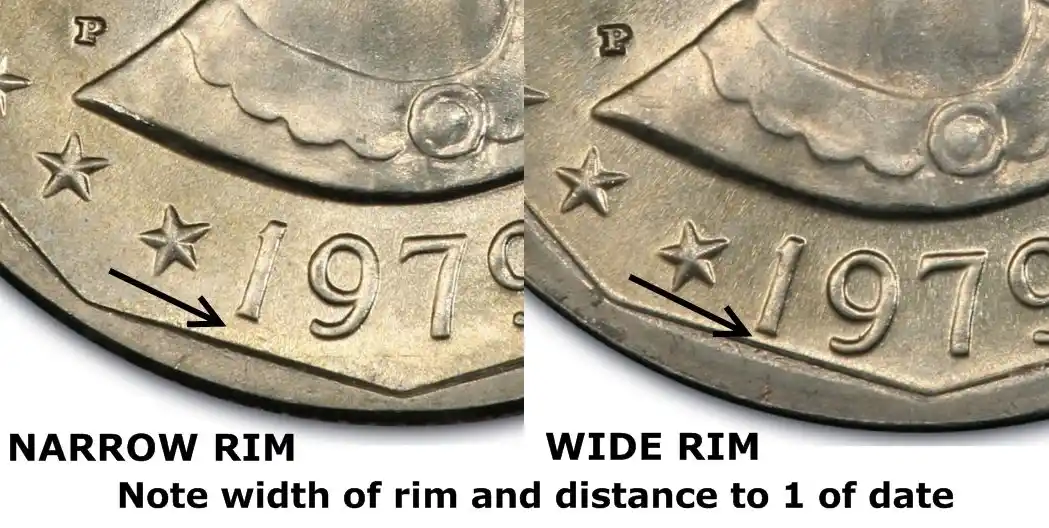
Philadelphia Mint workers used two different coin dies. This created two important rim varieties. This difference dictates coin market value.
Narrow Rim
People also call this the Far Date. Date numbers sit far from the coin border. This coin rim looks thin. This variety is extremely common. Mint state MS63 coin price is only $2-$4. Selling circulated pieces above face value is impossible.
Wide Rim
People call this scarce variety the Near Date. Date numbers sit very close to the coin border. This coin rim looks wide and flat. Philadelphia Mint workers used this Wide Rim die late in 1979. Mint production numbers are very low. This creates high investment potential.
| Coin Grade | Real Wide Rim Price Range |
| MS60 | $15-$25 |
| MS63 | $25-$35 |
| MS65 | $50-$75 |
| MS66 | $120-$180 |
| MS67 | $800-$1,000 |
Wide Rim dollar record price is $8,268.75. Auction firm GreatCollections sold this MS67+ coin. Another MS67+ specimen brought $6,995 at Heritage Auctions. Price differences between Narrow Rim and Wide Rim in MS65 grade exceed 500%.
Mint Luster Effect on Coin Price
Copper nickel metal blends react quickly with oxygen. Coins without original mint luster lose market value fast. Bright, frosty luster secures high coin grades. Price differences between dull MS65 coins and shining MS67 specimens reach $200-$500. Professional coin dealers view luster as a primary value factor. Shiny coins sell faster, bringing steady seller profit.
Proof Coin Values
San Francisco Mint workers made high-quality proof coins for collector sets. These issues have two different S mint mark styles.
Proof Type 1 Filled S
This S mint mark looks messy and filled with extra metal. Coin makers used this die early in production. These Filled S coins are very common.
| Coin Grade | Real Type 1 Price Range |
| PR65 | $5-$8 |
| PR67 | $8-$12 |
| PR69 | $12-$18 |
| PR70 | $30-$50 |
Type 1 proof dollar record price is $719. Collectors paid this for a coin without microscopic flaws. Most Type 1 coins sell in standard proof sets for $8-$10.
Proof Type 2 Clear S
This S mint mark has a clear shape. Letters look sharp. Coin makers used this Clear S die late in 1979. Total coin mintage was much lower. This raises market values.
| Coin Grade | Real Type 2 Price Range |
| PR65 | $20-$30 |
| PR67 | $30-$45 |
| PR69 | $45-$65 |
| PR70 | $130-$180 |
Type 2 proof dollar record price is $1,955. Clear S coin value constantly exceeds Type 1 prices by 300% to 400%. Investors buy these pieces for long-term hold.
Mint Errors and Coin Price Growth
Manufacturing mistakes cause high value growth for ordinary coins. Production errors sell well.
Double Die
Double strike action leaves double letters or date numbers.
- Rare error
- Value $50-$100
- Strong doubling $150-$300
Off Center
Planchet shift moves images away from the coin center.
- 10% shift: $40-$80
- 25% shift: $150-$250
- 50% shift: $300-$500
Clipped Planchet
Metal sheet defects leave curved cuts on coin borders.
- Visible clip
- Value $40-$90
- Easy sales
Annual Price Dynamics
Market price trends show different movements over 12-month periods. Coin classes behave differently.
- Standard MS63 coins lose 1% to 2% every 12 months
- Scarce Wide Rim MS67 coins grow 3% to 5% every 12 months
- Perfect Type 2 PR70 proofs show 2% growth every 12 months
- Rare MS68 coins lose 5% to 10% when new pieces appear
Regular coins without rare features do not bring investment profit. Capital grows only when buying certified rare varieties.
Practical Financial Tips for Sellers
Coin owners often lose cash due to simple mistakes without coin-identifier.com. Serious collectors follow strict rules.
Cleaning Damage
Mechanical or chemical coin cleaning destroys original metal surface layers. This results in a 50% to 80% price drop. A nice MS65 coin worth $15 becomes a damaged piece worth $1 after cleaning. Professional buyers identify clean marks instantly under microscopes.
Storage Risks
Cheap plastic holders cause chemical metal damage. Soft PVC plastic releases acidic chemicals. This creates a green residue layer on coin surfaces. Such metal damage ruins coin value completely. Collectors use hard plastic capsules instead.
Certification Cost
Sending coins for professional grading costs cash. Third-party grading fees at NGC or PCGS run $30-$50 per coin. Submitting cheap coins worth under $40 brings certain financial loss. Smart sellers certify only top-grade Wide Rim coins or major errors.
Long-Term Investment Appeal Analysis
Smart investors evaluate Susan B Anthony coins as portfolio diversification assets. Scarce type price stability is clear.
- Wide Rim MS66 demand reduces loss risks
- Type 2 PR70 liquidity remains very high
- Cheap MS60 coins at $1.5 attract new buyers
- Overproduction risk is zero because production ended
Adding certified high-grade coins to a metal portfolio makes sense. Profit collection works best over 60-month periods. Rare type capitalization grows slowly but surely.